11/19/05 - Posted from the Daily Record newsroom
Drew professor's artworks instruments, too
MADISON --Norman Lowrey sits at his desk, wearing a wooden mask he calls LongNose TreeSpirit.
The face piece is adorned with swirls of white beads, and its shape vaguely resembles the head of a wolf with an elongated nose. Tucked inside is a small electronic saxophone, which Lowrey plays, producing a bizarre noise that resonates in his basement office at Drew University.
"Technically, I say each mask has a sound installed," the Morris Plains man says.
"Metaphorically, I refer to that sound as the mask's voice."
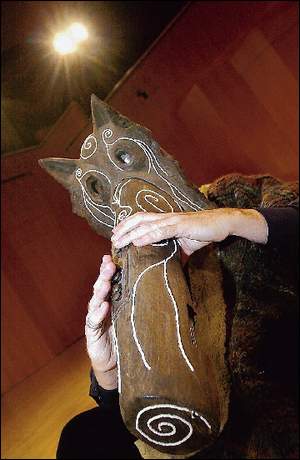
Norman Lowrey, chairman of the music department at Drew University, performs with one of his masks, Long Nose TreeSpirit -- aka Wolf.
Lowrey, the 61-year-old chairman of Drew's music department, is a self-proclaimed avant-garde composer who is constantly searching for new ways to create music. One way he has accomplished that over the decades is through handcrafting exotic masks that double as musical instruments. On Sunday, he will perform at Drew's new Dorothy Young Center for the Arts.
"Norman's work is fascinating," said Garyth Nair, a Drew music professor who conducts the orchestra and chorale. "It really asks youto push the envelope in terms of how music is employed inside the concert hall."
And unlike some contemporary composers, whose work sometimes is regarded as angst-provoking cacophony, Lowrey's performances can be spiritually healing, Nair said.
"This is not the kind of thing where you listen for an hour to squeaks and squawks that only the composer's mother or students will love," Nair said.
Lowrey has a doctorate in musical composition and has taught at Drew since 1977. His foray into mask-making was by chance.
"It is what's called serendipity -- an accidental discovery that led me into an entirely new direction," he said.
In 1979, he was invited to create music for 6-foot-tall ceramic columns featured in an art exhibit at Drew. Lowrey discovered that the columns hummed when air passed through them.
"I took the blower off the rear end of a vacuum cleaner and attached it so I could blow a constant stream of air," he said.
"I recorded that. I then manipulated the recording electronically to produce what in my consideration is music. ... It was the sound of her sculptures."
That initial experiment led him to make clay flutes, which he fashioned into forms like flowers and seashells. They grew larger and larger.
"One day, I was playing one, I realized it was covering my face like a mask," he said. "Then it came to me: I'd never heard of anyone who made masks that produced sounds. Masks had always covered the face, that's it."
His first mask was made of clay and had a built-in flute. He called it Earth Singer. Since then, he has produced more than 50 "Singing Masks," each with its own name and voice.
Many resemble animals, like Sheeoué Windhorse, which looks like a horse and produces a deep sound similar to a French horn.
Some are inspired by native peoples, like Inua Yua, a mask with a masculine face and an embroidered, cotton headdress. Its name comes from an Eskimo word for "image person," Lowrey said.
Other masks draw on ancient mythology. Consider the mask named Ra, the Egyptian sun god, that is striped with red and black paint and has wooden feathers shooting out from its face. The tribal-looking mask is not meant to be Ra; rather, the siren-like sound it produces -- thanks to two bagpipe reeds embedded within -- embodies the spirit of the ancient deity, Lowrey said.
"It's a bright, shouting sound," he said.
Students said they are intrigued by their professor's work.
"Coming here, I was a bit closed-minded regarding music that was avant-garde. I appreciate it a lot more now," said Kris Keyser, a sophomore from Chatham.
"It's something you can kind of lose yourself in, like a meditative state."
Lowrey has delivered his ceremonial performances -- named so because of the spiritual element -- across the country in alternative venues such as contemporary art galleries and festivals. He once played his masks outside pictograph caves during a Sierra Club conference in Montana.
This fall, he performed for scholars visiting the Drew campus for a theology and religion conference. His "Singing Masks" were accompanied by pre-recorded chirping birds and other earthy sounds.
"All of the scholars were quite moved by it," said Laurel Kearns, a Drew professor of sociology of religion and environmental studies.
"It just is magical. He's wearing these masks ... and you sort of forget he's the musician."
"It's both a concert and a dramatic performance."
Lowrey said he invites members of the audience to participate, whether they want to chant, dance or even sleep. His hope is that his work will foster good vibes and inspire an appreciation for the sacredness of life.
"I believe that such positive thought can be effective in countering all the negative that pervades our culture," he said. "I hope it will open people's hearts and minds to the real beauty and joy of life."
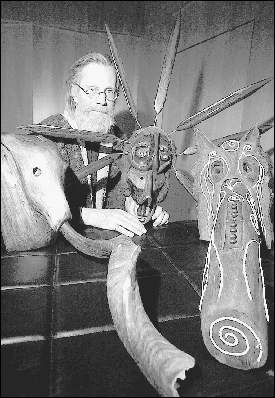
Norman Lowrey, chairman of the music department at
Drew University, shows off a few of his masks -- from left,
Sheeoué Windhorse, Ra, and Long Nose TreeSpirit -- aka Wolf.
Jenna M. McKnight can be reached at (973) 428-6634 or jmcknight@gannett.com.